
Állat
Western lowland gorilla
Hands, plant food and a bed built each day in the life of a great ape.
A tartalom nyelve
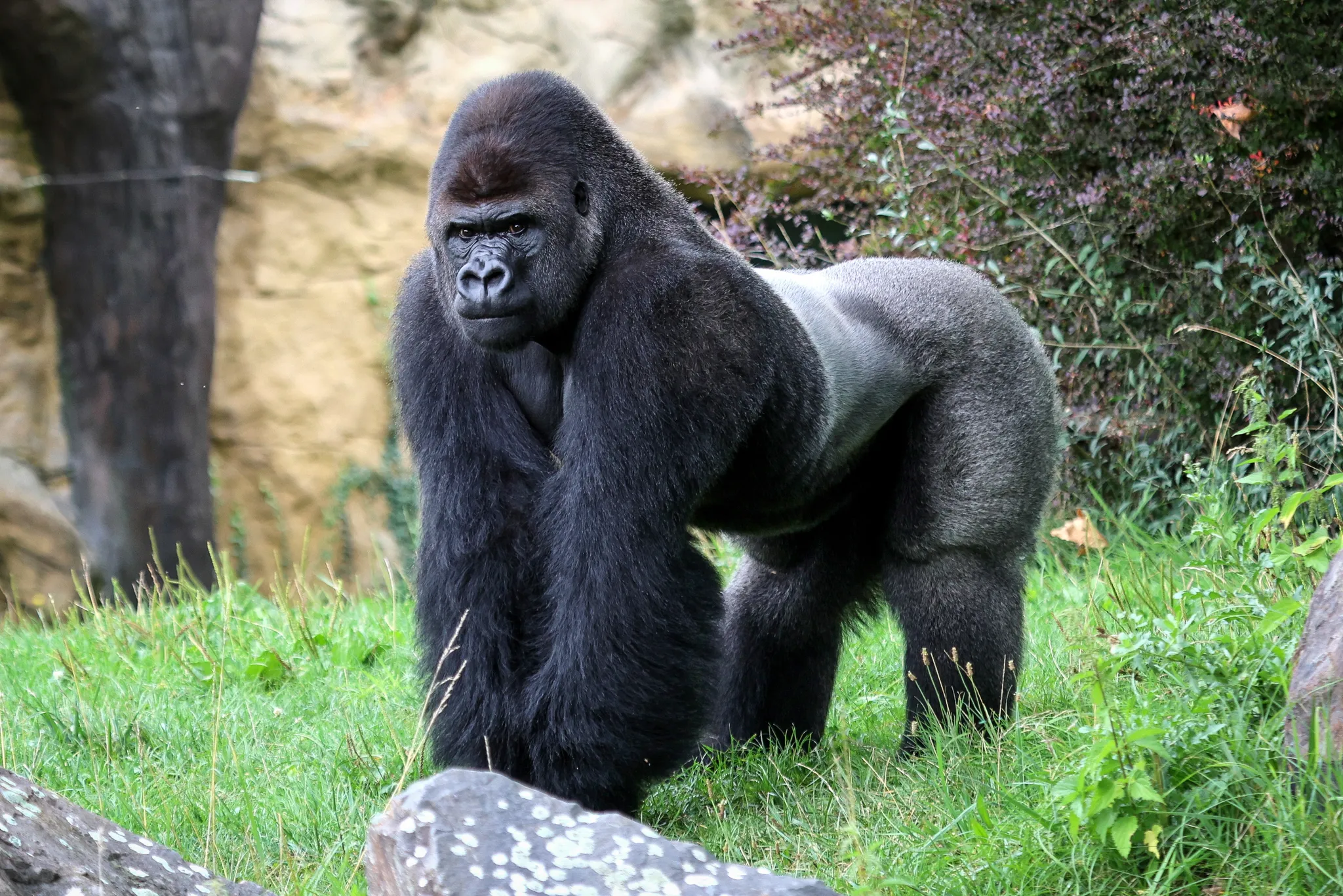
The western lowland gorilla belongs to the great ape family and is a subspecies of the western gorilla. An adult male usually weighs around 140-160 kilograms, while a female weighs 70-110. Standing upright, they can reach about 1.8 and 1.4 metres respectively, and a large male's arm span can reach an impressive 2.4 metres. Their dark fur varies in shades of grey and brown, sometimes with a reddish tinge on the head.
These gorillas are native to the rainforests of Central Africa, including Gabon, Cameroon and the Republic of the Congo. They also live in swampy areas. Although they are the most numerous gorilla subspecies, their future remains uncertain: they are critically endangered. Logging reduces their habitat, while poaching and diseases, including Ebola, contribute to declining numbers.
Looking at such a powerful animal, it may be hard to believe that plants form the basis of its diet: fruit, leaves, shoots and seeds. Ants and termites supplement the menu. On the ground, gorillas usually walk on all fours, resting on their knuckles. Despite their weight, they can also climb trees, for example to reach fruit. They grip branches with both their hands and their feet. Their days are divided between feeding, travelling and resting. At mealtimes, you might hear something surprising: soft sounds resembling humming or singing. Researchers have recorded these calls in wild gorillas, particularly adult males.
A typical family group consists of a silverback male, several females and their young. Both sexes may leave the group in which they were born. After a pregnancy lasting about eight and a half months, usually one infant is born, and births are often three to five years apart. Gorillas live for around 30-40 years in the wild. In human care, some even live beyond fifty.
Szakértői
The western lowland gorilla (Gorilla gorilla gorilla) is a subspecies of the western gorilla. It belongs to the family Hominidae, alongside orangutans, chimpanzees and humans. There are two species of gorilla: western and eastern. Mountain gorillas, familiar from Africa's mountain forests, belong to the latter species. This distinction matters because their habitat, diet and some behaviours differ from those observed in western lowland gorillas. 1
Body structure and the silver back
Gorillas show pronounced sexual dimorphism, meaning differences in the appearance and size of males and females. Adult males in the wild typically weigh around 140-160 kilograms, while females weigh around 70-110 kilograms. The silvery hair on a male's back develops as he matures. It therefore does not simply indicate old age, although it may remind us of greying hair in humans. 1
A large male can reach about 1.8 metres in height when standing upright, with an arm span of around 2.4 metres. Long forelimbs, a broad chest and a strongly muscled shoulder girdle give him a distinctive silhouette. The prominent crest on top of an adult male's skull provides enlarged attachment areas for the muscles that move the lower jaw.
The fur may be dark grey, brown or almost black. Much of the face is hairless. The pattern of wrinkles and the shape of the nose differ between individuals, allowing researchers to use these features to recognise particular animals. 2
Life in Central Africa's forests
Western lowland gorillas inhabit the forests of Central Africa, including Gabon, Cameroon and the Republic of the Congo. They use both forests on drier ground and wetland areas. Their habitat is not a uniform wall of green. It consists of different types of vegetation, fruiting trees, thickets and open, wet clearings.
Food availability changes throughout the year. Gorillas therefore need to find suitable feeding sites and adapt their use of the forest to the season. Understanding their behaviour requires many years of observation, because a picture obtained in one place or month may not reflect the full diversity of these animals' lives. 3
On the ground and in the treetops
On the ground, gorillas mainly move on all fours. They support the weight of the front of their body on the backs of their bent fingers. This form of locomotion is known as knuckle-walking.
They are also capable climbers. Young animals and females climb particularly often, entering trees to find food, among other reasons. The considerable weight of adult males limits the range of branches able to support them. A gorilla's agility should therefore be considered in relation to its age, size and the kinds of support it uses.
The day includes feeding, travelling and resting. For the night, gorillas build nests from vegetation, either on the ground or in trees. Such a bed is usually used for a single night. 4
Diet and digestion
Plants form the basis of the diet: fruit, leaves, shoots, stem pith and other available plant parts. The proportion of each component depends on the habitat and season. When fruit becomes scarcer, other food sources gain importance. Invertebrates, including ants and termites, may supplement the diet.
Plants vary in nutritional value and fibre content. A juicy fruit and a stem require different processing by the digestive system. Microorganisms living in the final part of the digestive tract help break down fibrous food. Microbial fermentation in the caecum and colon allows the animal to use some components that its own enzymes alone could not break down.
Aquatic and wetland plants are also important. Some provide readily available nutrients and minerals, making forest clearings valuable feeding sites. 5
Groups and social relationships
A typical group includes one adult silverback male, several females and their offspring. Its composition can change, however. Growing individuals leave their birth group, and females may move between groups. Males often live alone before establishing a group of their own.
Relationships are maintained through proximity, touch, play and communication. Young gorillas run, climb and wrestle. The area used by one group may overlap with areas used by others. The forest should therefore not be imagined as a collection of strictly separated territories whose boundaries are constantly defended. 4
Why do gorillas make sounds while eating?
One interesting behaviour is quiet humming or singing-like vocalisation during feeding. In a study of two wild groups of western lowland gorillas at Mondika in the Republic of the Congo, these sounds were recorded more often in adults and in males. How frequently they called also depended on the type of food they were eating.
This does not mean that we can translate every hum into a human "I like this food". Among other possibilities, the study's authors considered whether the sounds might help coordinate feeding within the group. Their function has not been conclusively established. This illustrates the difference between observing behaviour and interpreting its meaning: we hear a sound and know the circumstances, but cannot directly read the animal's motivation. 6
Tools and problem-solving
In 2005, researchers published an account of two observations of tool use by wild western lowland gorillas at the Mbeli Bai clearing in the Republic of the Congo.
A female named Leah by the researchers used a branch while entering the water. Her behaviour suggested that she was testing the depth or stability of the ground and supporting herself as she moved. Another female, Efi, used a detached piece of trunk as a support while gathering food, then placed it on boggy ground and walked across it.
The importance of these observations lies in documenting flexible use of objects in the natural environment. They do not demonstrate that all gorillas regularly use sticks. They do show that at least some individuals can use an available object to solve a particular problem. 7
Threats and conservation
The western lowland gorilla is classified as Critically Endangered. Major threats include hunting, habitat degradation and loss, and diseases, including outbreaks caused by the Ebola virus. Roads and other landscape changes can increase human access to previously hard-to-reach parts of the forest.
Conservation requires preserving sufficiently large areas of habitat, reducing hunting, monitoring populations and working with local communities. The mere presence of extensive forest does not guarantee the animals' safety if other threats are not also addressed. 3
Gorillas in human care
In a zoo, appropriate social relationships, a varied environment and opportunities to perform natural activities all matter. Climbing structures, resting places and different ways of presenting food allow animals to use their surroundings in many ways. The opportunity to retreat from public view is also important.
European zoos cooperate through the EEP programme, coordinating care of the gorilla population and breeding decisions. Work carried out in zoos should be connected with protecting the animals and their habitats in Africa. 1
Sources
- EAZA, Best Practice Guidelines for Western Lowland Gorilla, third edition, 2024. Guidelines on biology, care and population management. PDF document.
- Smithsonian’s National Zoo and Conservation Biology Institute, Western lowland gorilla. Subspecies profile.
- Western Gorilla, Western Lowland Gorilla. Distribution and threats.
- San Diego Zoo Wildlife Alliance Library, Western Lowland Gorilla: Behavior & Ecology. Behaviour and ecology.
- San Diego Zoo Wildlife Alliance Library, Western Lowland Gorilla: Diet & Feeding. Diet and digestion.
- Luef E.M., Breuer T., Pika S., 2016, Food-Associated Calling in Gorillas (Gorilla g. gorilla) in the Wild, PLOS ONE, 11(2), e0144197. Research paper.
- Breuer T., Ndoundou-Hockemba M., Fishlock V., 2005, First Observation of Tool Use in Wild Gorillas, PLOS Biology, 3(11), e380. Research paper.
Gyerekeknek
The western lowland gorilla is a real forest giant. An adult male can weigh more than two grown-ups, and his outstretched arms can span an amazing two metres and forty centimetres! He has dark fur, long arms and feet that can grip. His home is in the warm, wet forests of Central Africa.
What does a giant like this have for lunch? Mostly plants: fruit, leaves, shoots and seeds. Sometimes he eats ants and termites too. And while eating, he sometimes makes quiet sounds that resemble humming or singing. Scientists have heard these sounds from gorillas living in the wild, especially adult males.
On the ground, a gorilla usually walks on all fours, resting on the knuckles of its hands. It can also climb a tree, for example to reach fruit. It grips the branches with both its hands and its feet. Imagine your feet helping you hold onto a branch just like your hands! Young, lighter gorillas find it easier to move among the branches.
Gorillas live in family groups. These usually include a large male with silvery fur on his back, several females and their young. A baby gorilla first travels snuggled against its mum, then rides on her back. In her care, it gets to know the world around it.
Sadly, gorillas need protection. The forests where they live and find food are being cut down. Poachers and diseases threaten them too. Protecting their forest home also helps save many other animals and plants.
- Elhelyezkedés
- Enclosure no. 11 on the Zoo Opole map.