

Punto di interesse
Monastery Gate
A former defensive entrance to the hill, remodelled during the Baroque period.
Lingua dei contenuti
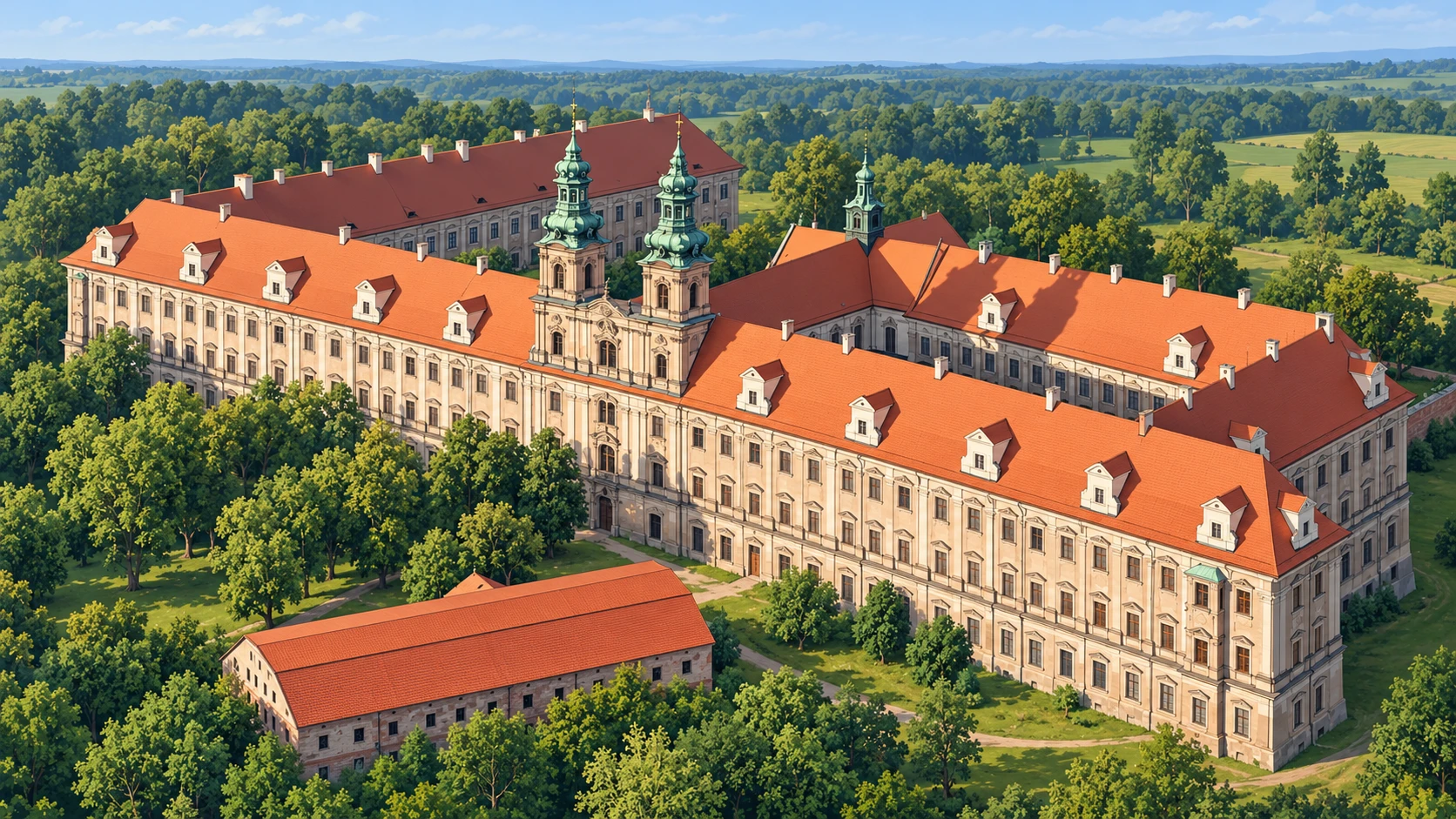
The Monastery Gate was built in 1601 as a defensive structure. Its present form results from an enlargement carried out in 1710. From the north, the approach crosses a stone bridge over a moat established around 1509. These successive parts of the entrance combined a crossing over an obstacle with controlled access to the walled monastery hill.
An elaborately decorated gable crowns the gate’s northern elevation, with figures of Saints Benedict and Bernard placed in niches. On the right stands the adjoining former monastery hospital, built in the early eighteenth century. On the left, a tall wall with a gate separated the former vegetable garden and orchard from the approach road. Beyond the gate the road continues past service buildings towards the monastery square. The gate thus represents a different aspect of the abbey from its ceremonial rooms, combining defence, circulation and the needs of its working estate. It is described as an exterior sight, without implying access to rooms inside.
Per bambini
The Monastery Gate controlled the entrance to the abbey grounds. It was built in 1601 and enlarged more than a century later, in 1710. A bridge over the former moat approaches it from the north. The moat formed an obstacle around the hill, while the gate controlled who could pass through.
Figures of Saints Benedict and Bernard stand in the decorated upper part of the building. The monastery hospital was on one side. On the other, a wall separated the road from a vegetable garden and orchard. Beyond the gate, the road continues towards the square and main buildings. This structure tells of access, protection and the monastery’s everyday services. Seeing it from outside does not mean that every room inside is open.
Domanda 1 di 2
What was the gate’s original function?
- Posizione
- Northern entrance to the abbey grounds; viewed from outside.