
Sála · Designed in 1912; Baroque model; furnishings mainly from the seventeenth and eighteenth centuries
Patrician merchant's house
A model Baroque merchant's townhouse illustrates the role of trade in Jelenia Góra's development and the culture of its urban residents.
Jazyk obsahu
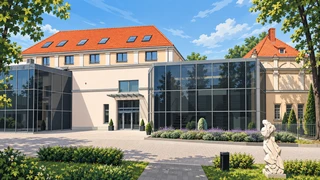
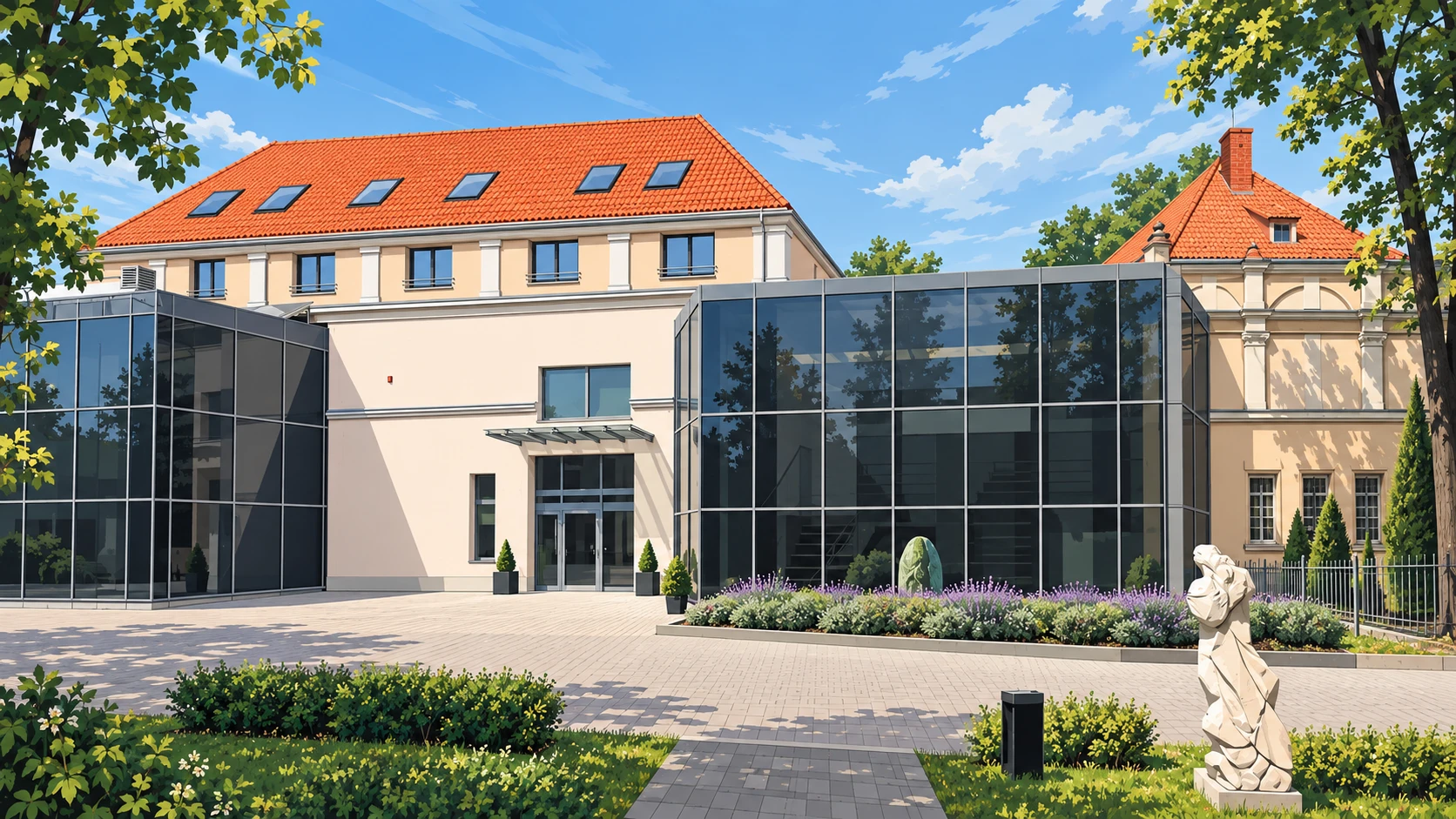
The Patrician House is a reduced-scale model of a Baroque merchant's townhouse. Carl Grosser designed it in 1912, alongside the wider museum complex. Its model was house no. 22 on Jelenia Góra's market square, owned by merchant Daniel von Buchs. Hugo Seydel intended it to acknowledge the merchants who helped drive the town's development for about 150 years.
The façade has Baroque arcades, the Merchant Society's three-masted ship on waves and the inscription “DEO BEANTE”. A stucco seahorse in the vestibule was made by Luber, a sculptor from Görlitz. He also created the surviving ceiling decoration of Mercury, patron of merchants, based on stucco from Daniel von Buchs's house at 16 Kilińskiego Street.
The parquet copies a salon floor from market-square house no. 33, while the window panes came from eighteenth-century Jelenia Góra houses. Today's salon furnishings are not the original complete set, but an arrangement illustrating the wealth of the eighteenth-century merchant community.
Otázka 1 z 2
Which market-square house served as the model for the Patrician House?
- Poloha
- Patrician house on the garden side · Museum complex · ground floor · Patrician house
- Autor alebo pôvod
- Muzeum Karkonoskie w Jeleniej Górze
- Signatúra
- PKT-MK-03
- Baroque
- merchants
- Jelenia Góra
- townhouse
- urban society