
Jawor, dolnośląskie
Kościół Pokoju w Jaworze
A UNESCO-listed timber church with four tiers of galleries, a Baroque pulpit and altar. The history of Jawor’s Lutherans preserved in construction, paintings and gifts.
Sledováním souhlasíte s e-mailovými a push oznámeními od tohoto místa. Každý kanál můžete vypnout v nastavení.
Jazyk obsahu
Kościół Pokoju w Jaworze
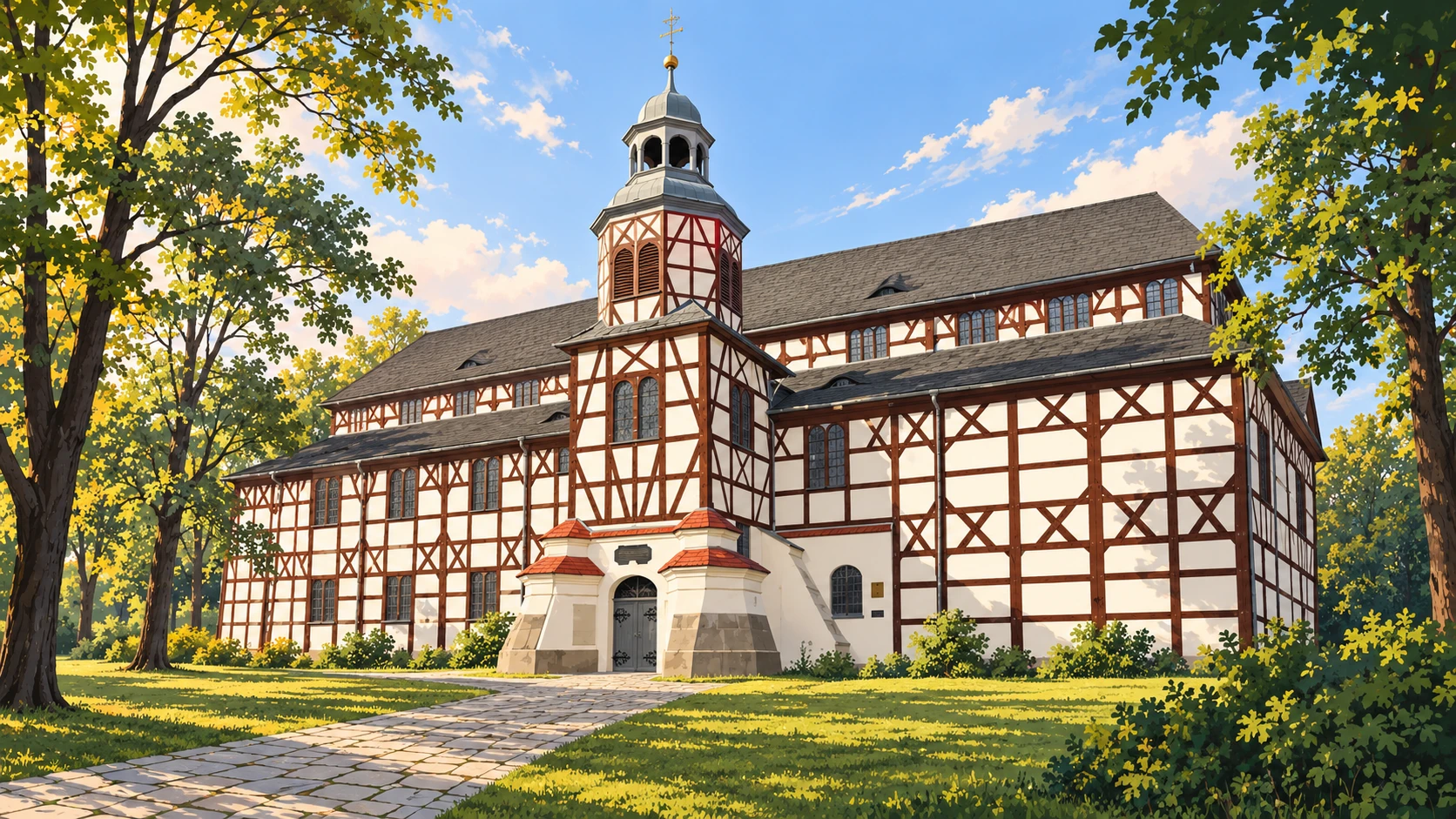
Timber, clay and straw became the materials of the large church built by Jawor’s Lutherans after the Thirty Years’ War. Permission to build followed the Peace of Westphalia, but came with restrictions. The church had to stand outside the town walls, without a tower, and be paid for by the congregation. Funds were also raised beyond Silesia.
Master carpenter Andreas Gamper carried out Albrecht von Säbisch’s design. Construction took place in 1654-1655, and the first service was held on the fourth Sunday of Advent in 1655. The church was dedicated to the Holy Spirit. The network of beams visible on the façades forms its structure; inside, galleries surround the nave and aisles.
Successive generations added to the furnishings. Four tiers of side galleries were decorated with biblical scenes, coats of arms and craftsmen’s emblems. An angel supports the pulpit, while the altar combines Baroque sculptures with a nineteenth-century painting of Christ at prayer. The font, confessionals and pastor’s stall relate to specific religious practices and benefactors. Lummert’s organ represents a later, nineteenth-century stage in the interior’s history.
The church remains a Lutheran place of worship. It was inscribed on the UNESCO World Heritage List in 2001 and is surrounded by Peace Park, formerly a cemetery. Visitors can listen to its history in a recording available in eleven languages. A separate digital project has focused on the building’s exterior and selected furnishings.
Pro děti
This church has a wooden skeleton. It was built by Lutherans who wanted their own place to worship after a long war. They were allowed to build, but had to follow many rules: the church had to stand outside the town walls, without a tower, using timber, clay and straw. Money for the work was also collected in distant places.
Albrecht von Säbisch drew up the design, and carpenter Andreas Gamper led work on the timber structure. Construction took place in 1654-1655. The first service was held towards the end of 1655. The church was dedicated to the Holy Spirit.
Inside are four tiers of galleries, rather like balconies. Their paintings show biblical stories, family coats of arms and craftsmen’s emblems. An angel stands beneath the pulpit. The altar contains a painting of Jesus praying. The font was needed for baptism, and the pastor’s stall provided a seat for the minister. Each object had its own purpose.
The church still serves the Lutheran community and is a UNESCO World Heritage Site. A park surrounds it where there was once a cemetery. A visit can be accompanied by a recording telling the story of the place. It has been prepared in eleven languages.
Novinky místa
Načítání novinek…
April-October
1. dubna – 31. října
- pondělí
- 10:00–17:00
- úterý
- 10:00–17:00
- středa
- 10:00–17:00
- čtvrtek
- 10:00–17:00
- pátek
- 10:00–17:00
- sobota
- 10:00–17:00
- neděle
- 12:00–17:00
From 1 April to 31 October: Monday-Saturday 10:00-17:00; Sundays and church holidays 12:00-17:00. From 1 November to 31 March, visits are available only to groups of at least 6 people, booked by phone or email at least one day in advance. Winter visiting times are arranged when booking. A typical visit takes about 20-40 minutes; the recorded history lasts 10-17 minutes depending on the language. Contact: +48 516 493 990, jawor@luteranie.pl.
Adresa
Park Pokoju 259-400 Jawor