
Animal
Rothschild's giraffe
The tallest land mammal reaches for leaves with a grasping tongue and chews its food again.
Content language
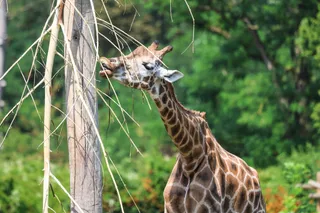
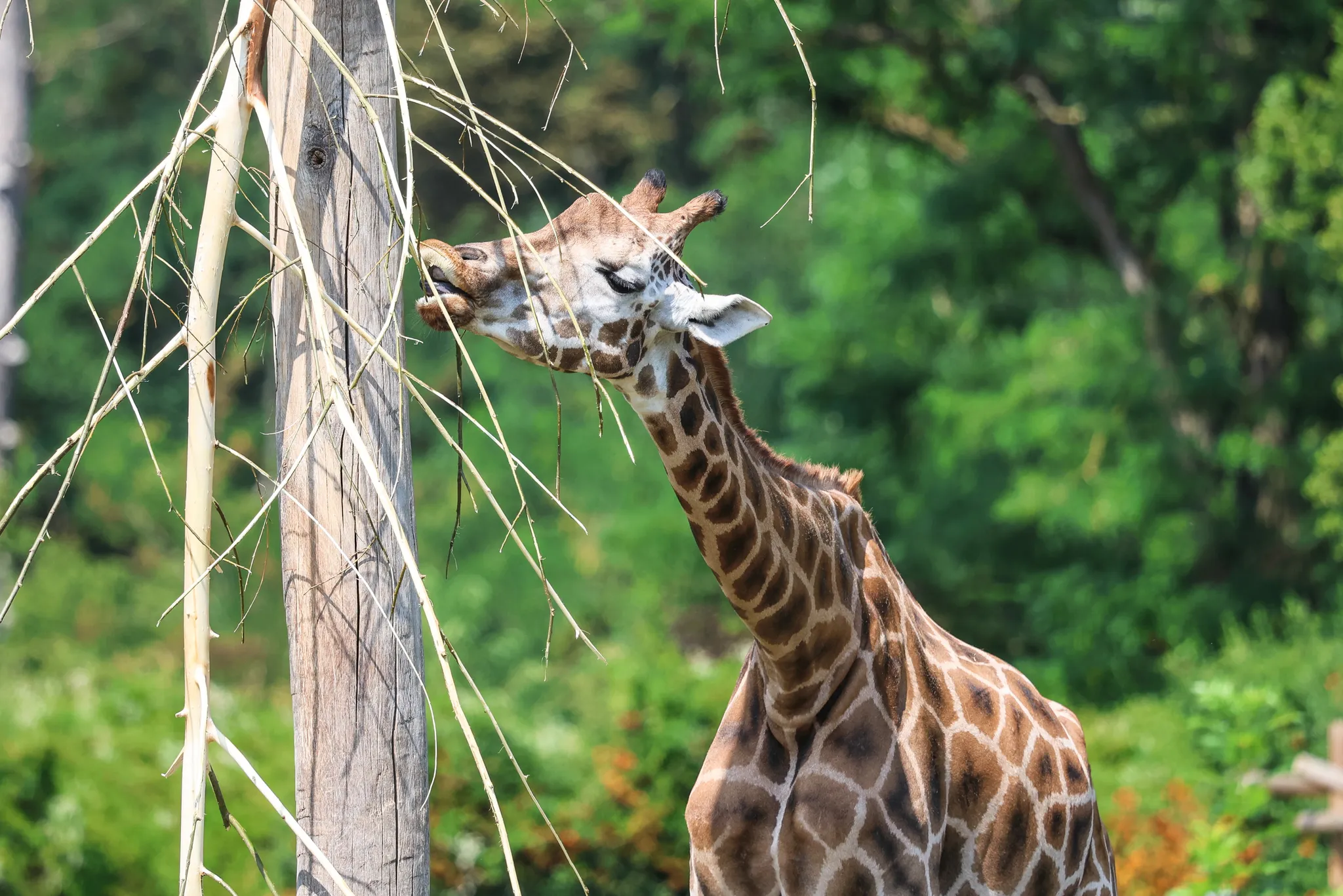
Opole Zoo keeps Rothschild's giraffes. Their great height comes from both a long neck and long legs, allowing them to reach branches beyond many other plant-eaters. Trees on the African plains offer giraffes a feeding level above the ground vegetation.
A long, prehensile tongue and mobile lips help them pluck leaves. These allow a giraffe to work around acacia thorns and select tender plant parts. It takes small mouthfuls at a time, so feeding occupies much of its day. A long neck alone would be less useful without this precise work of the mouth.
Giraffes are ruminants. After plants are swallowed, food returns to the mouth to be chewed again, while a stomach with four compartments helps digest it. A resting giraffe moving its jaw may therefore still be processing a meal without taking any new leaves.
Each coat has an individual pattern of patches that helps break up the outline among leaves and shadows. Both males and females have skin-covered bony projections on the head. A calf is born while its mother stands and soon begins trying to stand and walk itself.
For children
A giraffe can reach high, but it needs more than a long neck to get its food. Its tongue can grasp leaves, helped by flexible lips. Together they let it select food even from thorny branches. Opole's giraffes belong to the form known as Rothschild's giraffe.
The meal is not finished after the first swallow. A giraffe chews its food again when it returns to the mouth. Its stomach has four compartments. If it stands quietly moving its jaw, it may be breaking down plants it ate earlier.
Every giraffe has a different pattern of patches. Among leaves and shadows, these help hide the shape of its body. Skin-covered bony projections are visible on the head too. Young giraffes soon learn to stand and walk, even though their legs are already very long.
Question 1 of 2
What helps a giraffe pluck leaves precisely?
- Location
- Enclosure no. 55 on the Zoo Opole map.