
Krzeszów, dolnośląskie
Opactwo Pocysterskie w Krzeszowie
Baroque churches, ducal tombs and pilgrimage chapels form a former Cistercian abbey complex where religious life continues.
By following, you agree to email and push notifications from this venue. You can turn each channel off in settings.
Content language
Opactwo Pocysterskie w Krzeszowie
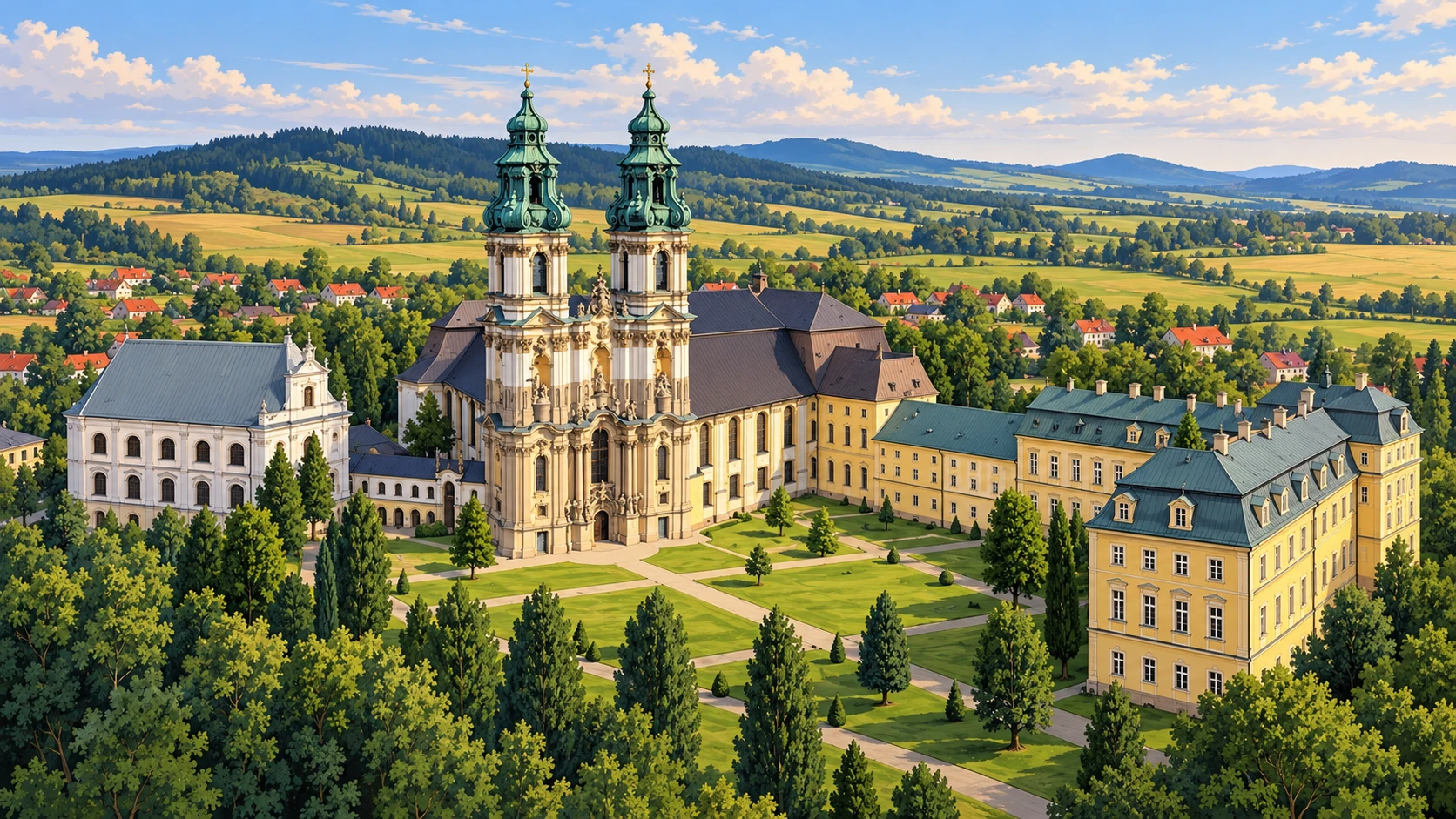
In Krzeszów, a monumental basilica stands beside a church whose walls are covered with stories painted by Michael Willmann. In the ducal mausoleum, medieval sarcophagi are surrounded by Baroque decoration. Nearby are buildings with entirely different purposes: a convent, a house for lay guests and pilgrimage chapels. The former abbey’s history is recorded in its architecture, pictures and changing uses.
The Basilica of the Assumption was built in 1728-1735. Its furnishings combine Peter Brandl’s great painting with a thirteenth-century icon of Our Lady of Grace and Michael Engler the Younger’s organ. Saint Joseph’s Church served parishioners and a religious brotherhood. Its paintings depict the Holy Family’s ancestors and Joseph’s joys and sorrows. Dukes associated with the abbey’s foundation, including Bolko I the Strict and Bolko II the Small, were buried in the mausoleum.
The complex’s history extends beyond the main square. Calvary chapels bring Gospel events into the local landscape. At Betlejem, the Nativity Chapel reproduced the grotto of Jesus’ birth, while an octagonal waterside pavilion served as a place of prayer for the abbot. These buildings have their own histories and separate locations.
The convent buildings preserve traces of unfinished plans and changing communities. Benedictine nuns who arrived from Lviv have lived here since 1946. Krzeszów remains a place of worship, where historic interiors continue to serve religious purposes.
For children
In Krzeszów, buildings and pictures help tell the story of the past. The former Cistercian abbey consists of churches, a convent, a guest house and chapels. Each had a different purpose: prayer, daily life, welcoming visitors or remembering the dead.
The great basilica was built between 1728 and 1735. Inside are an enormous altar with Peter Brandl’s painting and a much older picture of Our Lady of Grace. In neighbouring Saint Joseph’s Church, Michael Willmann painted more than 50 scenes showing Jesus’ family and events in Joseph’s life. The dukes’ tombs are in a mausoleum, a special room intended for burials.
The Calvary and Betlejem chapels stand farther from the main buildings. A Calvary is a group of places recalling the story of Jesus’ Passion. At Betlejem, a chapel was built to resemble the grotto of his birth, alongside an eight-sided pavilion over the water.
The convent is not an empty historic building. Benedictine nuns from Lviv have lived here since 1946. The old architecture still serves a religious community and people who come to pray.
Venue news
Loading news…
1 May - 15 October
May 1 – October 15
- Monday
- 08:00–18:00
- Tuesday
- 08:00–18:00
- Wednesday
- 08:00–18:00
- Thursday
- 08:00–18:00
- Friday
- 08:00–18:00
- Saturday
- 08:00–18:00
- Sunday
- 08:00–18:00
16 October - 30 April
October 16 – April 30
- Monday
- 08:00–16:00
- Tuesday
- 08:00–16:00
- Wednesday
- 08:00–16:00
- Thursday
- 08:00–16:00
- Friday
- 08:00–16:00
- Saturday
- 08:00–16:00
- Sunday
- 08:00–16:00
These hours apply to the main Tourist Route, not to every Calvary chapel or building at Betlejem. The visitor office is open 1 May - 20 October 9:00-18:00 and 21 October - 30 April 9:00-16:00. Attic and tower visits are offered on Saturdays and Sundays in July and August.
Tourist Route
- Standard ticket
- PLN 30.00
- Reduced ticket
- PLN 25.00
- Child ticket
- PLN 20.00
- Children under 6
- free
Discover Engler - organ presentation
- During the Summer Organ Concerts
- PLN 15.00
- Off-season, by advance booking
- PLN 30.00
Additional guide service for groups of up to 50
- Polish-speaking guide, per group
- PLN 150.00
- English-, German- or Czech-speaking guide, per group
- PLN 300.00
Tickets are available on site. Individual admission includes an audio guide in Polish, English, German, Czech, Russian, French or Italian. Bring headphones or buy disposable ones. Reduced admission covers groups of more than 15, schoolchildren, students up to age 26, disabled visitors and carers, pensioners and Polish Large Family Card holders. Ask the ticket office which child or reduced category applies. Escorts and tour leaders accompanying organised groups enter the Tourist Route free. Photography and toilets are included. Guide services require advance booking.
Address
Plac Jana Pawła II 358-405 Krzeszów