
Salle
Houses of the stronghold
Reconstructed homes introduce the buildings and community of the early medieval settlement.
Langue du contenu
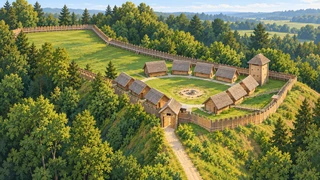
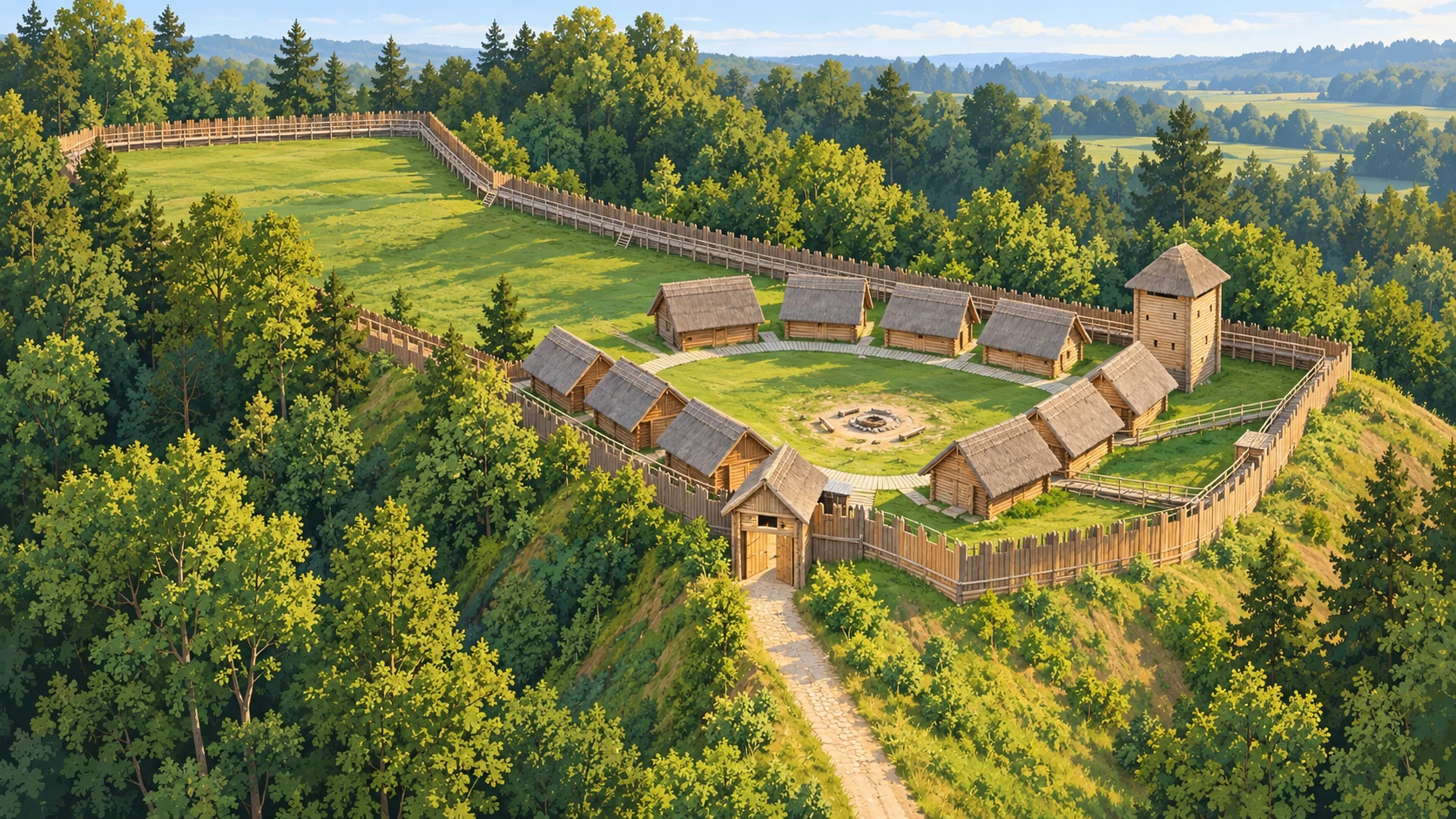
Ten reconstructed houses make up the residential buildings of the present-day stronghold. They include a herbalist’s house and a fisherman’s house, recalling the different occupations of the inhabitants. Historical homes included log-built houses with thatched roofs as well as partly sunken dwellings. Log construction means that walls were made from horizontally stacked timbers. A sunken dwelling was built partly below ground level.
An open space called the majdan remained between the houses. It was a meeting place for the inhabitants, giving the residential area a shared outdoor space. The stronghold housed the local lord and his family, religious representatives, warriors, leading craftspeople and wealthier merchants. Poorer people lived in the outer settlement. Where people lived was therefore linked to their position in the community. When looking at the buildings, distinguish this historical picture from today’s demonstrations and workshops, which take place on scheduled dates.
Seven of the ten houses are open to visitors; the other three are used for workshops and are not open for sightseeing. Individual visitors can explore the interiors of the houses open to visitors, as well as the observation tower and gate tower, on their own.
Pour les enfants
The houses of the stronghold help us picture earlier homes. Ten have been reconstructed here, including those of a herbalist and a fisherman. People did different kinds of work, and their homes stood close together inside the stronghold.
Some historical houses were built from wooden logs and roofed with thatch. Others were partly sunk into the ground. An open space between the houses was called the majdan. People gathered there. Warriors, merchants, craftspeople and the local lord’s family lived in the stronghold. Poorer people had homes outside its defences.
Seven of the ten houses are open to visitors; the other three are used for workshops and are not open for sightseeing.
Question 1 sur 2